Dating app users complain about price more than any other app category
Dating apps get the same bug reports as every other app: messages that don't load, profiles that vanish, photos that won't upload. But when we compared their reviews with those of 204 other apps, one thing stood out. Dating app users write about money far more than anyone else.
The numbers
We took the latest 300 App Store reviews for each of 10 dating apps: Tinder, Bumble, Hinge, OkCupid, Match, Grindr, Feeld, HER, Coffee Meets Bagel and Hily. That is 3,000 reviews from the US, UK, Canadian and Australian storefronts, fetched in October 2026.
An AI classifier tagged each review with zero or more of seven themes: bugs, pricing and subscription, feature requests, UX, performance, crashes and ads. 1,931 of the 3,000 reviews contained at least one complaint.
1,170 reviews complained about price or the subscription. That is:
- 39.0% of all 3,000 reviews
- 60.6% of the reviews with any complaint
Across all 214 apps we have reports for (67,350 reviews), the pricing figure is 15.9% of all reviews. Dating is the highest of every category with at least three apps. Budgeting apps come next at 30.9%, then food delivery at 29.1%.
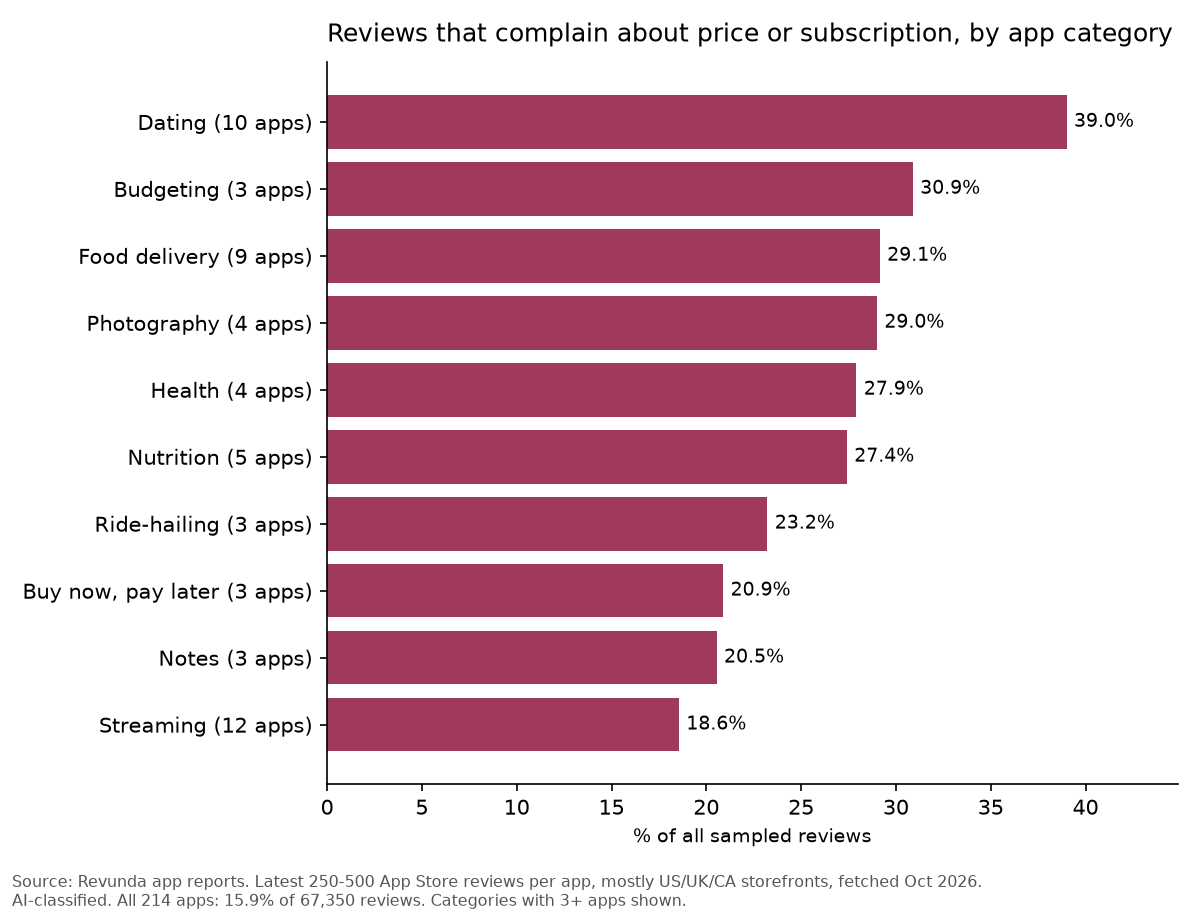
Pricing was the most common complaint, or tied for it, in 9 of the 10 apps. The exception is Feeld, where bugs (134 reviews) edge out pricing (132).
App by app
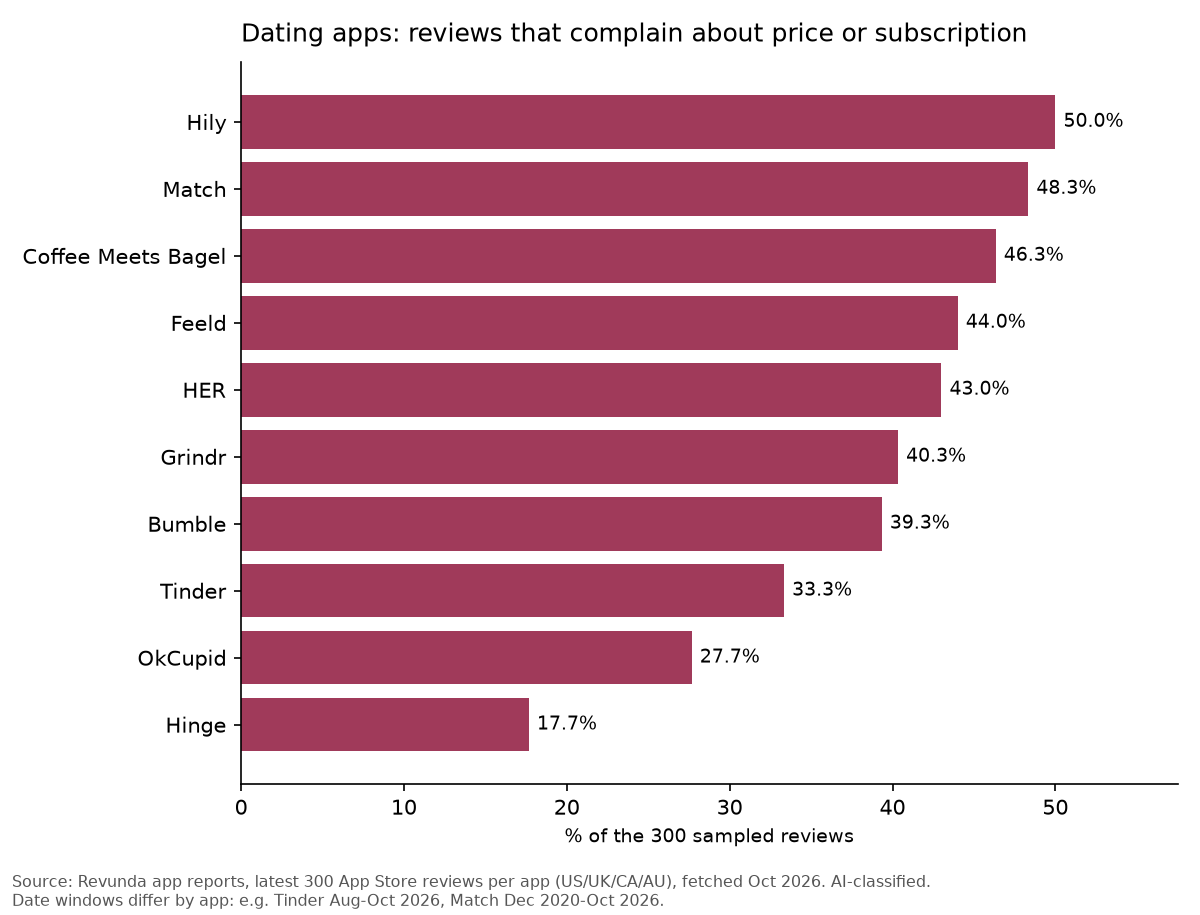
| App | Reviews that mention price or subscription (of 300) |
|---|---|
| Hily | 150 (50.0%) |
| Match | 145 (48.3%) |
| Coffee Meets Bagel | 139 (46.3%) |
| Feeld | 132 (44.0%) |
| HER | 129 (43.0%) |
| Grindr | 121 (40.3%) |
| Bumble | 118 (39.3%) |
| Tinder | 100 (33.3%) |
| OkCupid | 83 (27.7%) |
| Hinge | 53 (17.7%) |
Hinge is the outlier. Its 300 reviews average 2.88 stars, against 1.92 for Tinder, 1.68 for Bumble and 1.45 for Match. Fewer of its reviewers are angry, and fewer of the angry ones are angry about money.
One caveat matters here. "Latest 300 reviews" covers very different time spans. Tinder's 300 start on 29 Aug 2026. Bumble's start on 23 May 2026. Match gets so few new App Store reviews that its 300 go back to December 2020. So treat the Match figure as several years of opinion, and the Tinder figure as the last two months.
What people actually say
Most of the price complaints are not "it costs too much" in the abstract. They fall into three patterns.
Paying and still getting nothing. This is the most common shape. The user paid, and the thing they paid for (matches, replies, visibility) didn't arrive.
"I was getting matches when I first joined now even with subscription and paying for boost there are no matches." (Tinder, 1 star, Canada)
"You dont get matches,you dont get messages,its expensive an not worth it" (Hily, 1 star, UK)
Free features moved behind the paywall. Long-time users notice when something they used to get for free now costs money, and they say so.
"Features that used to be free before are all now locked behind a paywall. The fact that i can only see 12 people for free is literally insane compared to a fee years ago" (Grindr, 1 star, US)
"I remember when this app actually felt usable without paying." (HER, 1 star, Canada)
"Makes no sense why the core features of this app are behind a paywall. But don't worry, they give you a couple free likes before asking you to pay up." (Hinge, 1 star, Canada)
The price itself, quoted. Some reviewers name the number.
"now you either commmit to months on end or pay 28$ a week- are you insane? This app is now ridiculously expensiv[e]" (Bumble, 1 star, Canada)
"This is expensive to use and not worth the prices at all." (Coffee Meets Bagel, 1 star, US)
Quotes are trimmed for length but otherwise left as written.
Why dating apps get this more than other apps
A few reasons fit the data, though we can't prove them from reviews alone.
First, the product is an outcome, not a tool. A budgeting app works the moment you open it. A dating app only "works" when another person replies. When that doesn't happen, a subscription feels like paying for nothing, and the review says exactly that.
Second, the pricing is layered. Subscriptions, weekly plans, boosts, super likes and "see who liked you" are all separate. Reviewers often mention two or three of them in one sentence, which tells you they're doing the maths and don't like the total.
Third, the free tier keeps shrinking. "Used to be free" shows up across several apps, not just one. Users who have been on an app for years compare it to the version they remember.
What a dating app team could do with this
These are suggestions drawn from the review text, not results we measured.
- Separate "no matches" from "too expensive". Many price complaints are really about results: the user paid and nothing happened. Tag those apart from complaints about the price level, because the fixes differ.
- Watch reviews after any free-tier change. "Used to be free" is a direct reaction to a change. If you trim the free tier, expect it in your next 300 reviews and count it.
- Read the weekly-plan complaints carefully. When people quote a weekly price, the plan structure itself is the complaint, not just the level.
- Study the outlier. Hinge sits in the same category with roughly a third of Match's price-complaint share. Its reviews are a cheap way to see which paywall choices users tolerate.
How we did it
- Reviews: latest 300 public App Store reviews per app, from the US, UK, Canada and Australia, via Apple's public reviews feed. Fetched October 2026.
- Classification: an AI model tagged each review with any of seven themes. A review can have several. "Complaint" means the review has a theme and is either rated 3 stars or lower or was marked as a serious issue.
- Category comparison: 214 apps in our reports, 67,350 reviews. Only categories with 3 or more apps are compared.
- Limits: App Store only, English-speaking storefronts, and the time windows differ by app (see above). Reviews come from people motivated enough to write one, so they lean negative.
We collect the patterns for the whole category in our guide to why users complain about dating apps.
Want the same breakdown for your app or a competitor's? Revunda's free check reads the latest reviews and sorts the 1 to 3 star ones into themes. No signup.
Free chapter: Login is the real crash (PDF, pay what you want)